Restoring Austrian Roots
Restoring Austrian Roots is an Austrian NGO helping descendants of people persecuted by the Nazi regime find the historical sources and institutions they need to explore their Austrian family history and understand the documentary foundations of a possible path to Austrian citizenship.
Citizenship can be restored. The history often has to be reconstructed first.
Descendants of people who were persecuted by the Nazi regime in Austria may be eligible to acquire Austrian citizenship without giving up their existing citizenship.
For many families, however, the path begins with history: proving who the persecuted ancestor was, reconstructing the family line, locating the relevant Austrian records and understanding the circumstances of persecution, flight or exile.
Restoring Austrian Roots explains where these records can be found, how they fit together and what historical documentation is typically relevant. We do not provide legal advice or individual legal assessments. Detailed information on the citizenship process and the applicable rules can be found below.
From family story to documentary trail
Start with what the family knows
Names, dates, places, passports, letters, photographs and oral history can provide the first clues.
Identify the Austrian sources
Parish registers, civil records, residence files, citizenship records, address directories and archival holdings may establish identities and family relationships.
Document persecution and departure
Historical records may establish flight, expulsion, loss of rights, deportation, expropriation or emigration.
Assemble the documentary chain
The evidence must make the relationship between the present-day applicant and the persecuted Austrian ancestor understandable and verifiable.
Prepare the historical documentation
Applications may require a professional genealogical and historical report that brings the evidence together, explains the historical context and provides a neutral, source-based historical analysis.
Where do I submit my declaration?
If you live abroad
File your declaration with the Austrian Embassy or Consulate General responsible for the consular district of your principal residence. The diplomatic representation receives your declaration and supporting documents and forwards the case to the competent citizenship authority in Austria.
Forms & online questionnaire
The Austrian Foreign Ministry provides an online questionnaire for descendants. It gives case-specific guidance, identifies documents that may be required and produces a pre-filled declaration form. Using the questionnaire is recommended, but it is not mandatory.
Where is it processed in Vienna?
For many applicants living abroad, the competent Austrian authority is the City of Vienna, Municipal Department 35 (MA 35), Citizenship Department, Unit 8.2 — Acquisition of Citizenship by Victims of National Socialism. The office is at Dresdner Straße 89–93, 1200 Vienna. E-mail: 82-ref@ma35.wien.gv.at.
If your principal residence is in another Austrian province, the competent provincial government office is responsible. Applicants living abroad should begin with their local Austrian diplomatic representation.
More than a bundle of certificates
A good report turns scattered records into a coherent, verifiable historical account.
In straightforward cases, civil-status documents may be enough to establish the line of descent. In more complex cases, however, simply collecting birth, marriage and death certificates can leave important gaps unresolved. Names change, records are missing, families moved across former borders and the circumstances of persecution are not always visible in a single document.
A professionally prepared genealogical-historical report can reconstruct the family line, identify and evaluate archival evidence, explain historical inconsistencies and place persecution, flight or displacement in its proper context. Its purpose is not to replace the legal assessment of the Austrian authorities, but to present the historical facts and sources in a clear, neutral and verifiable form.
Restoring Austrian Roots itself does not prepare individual reports and does not provide legal advice. Our role is educational: we explain what strong historical documentation can contain, which Austrian sources may be relevant, how archives work and when independent professional assistance may be useful.
Finding professional help
Where a case requires deeper research, applicants may choose an independent genealogist or historian with experience in Austrian archival sources, historical migration and the documentation of Nazi persecution.
These links are provided as examples only. Restoring Austrian Roots does not require applicants to use any particular provider and receives no commission or remuneration for these references.
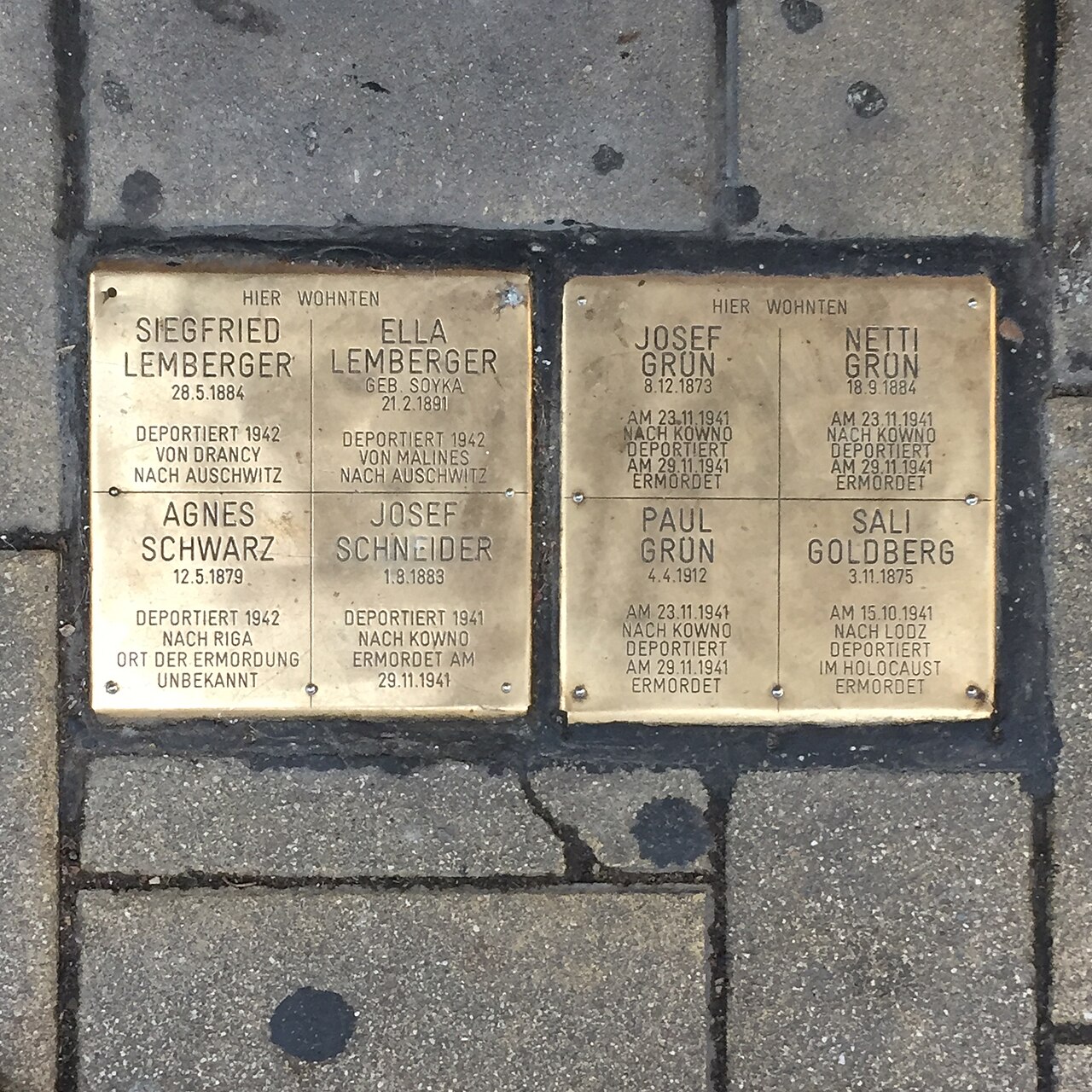
Memorial stones for victims of National Socialism in Vienna-Neubau. Photo: Christian Michelides / Wikimedia Commons. Licensed under CC BY-SA 4.0.
Where family history survives
Parish & civil records
Births, baptisms, marriages and deaths are often the backbone of a documented family line.
Residence records
Meldezettel, address directories and municipal files can reveal where a family lived and when it moved.
Citizenship records
Historical citizenship, Heimatrecht and municipal files may help clarify legal and administrative status.
Persecution records
Files relating to persecution, confiscation, deportation and restitution may document what happened to a family.
Emigration sources
Passports, border records, passenger lists and foreign registrations can help reconstruct the route out of Austria.
Archives & databases
Knowing which archive holds which record is often more important than knowing a document exists.
Important institutions

Historic archival records are often the starting point for reconstructing family histories and documenting persecution, flight and descent.
Getting oriented
Who is eligible – and do I potentially qualify?
Section 58c may apply to you if you are a direct descendant of a person who was persecuted, or had reason to fear persecution, by the Nazi regime or because of their support for the democratic Republic of Austria.
As a first orientation, ask yourself:
- Was your parent, grandparent, great-grandparent or another direct ancestor persecuted, or threatened with persecution, by the Nazi regime?
- Was that person an Austrian citizen, a citizen of one of the relevant successor states of the former Austro-Hungarian Monarchy, or a stateless person whose main residence was in Austria?
- Did your ancestor leave Austria because of that persecution or threat of persecution? Depending on the individual case, departures before 15 May 1955 may be relevant.
- Are you descended from that person in a direct line?
- Were you adopted as a minor? Persons adopted while minors can also qualify as direct descendants.
Children, grandchildren, great-grandchildren and further direct descendants may apply. Your parent or grandparent does not need to acquire Austrian citizenship first.
These questions are only a first orientation. Every case is different, and eligibility ultimately depends on the precise requirements of Section 58c and the individual historical circumstances of the persecuted ancestor. This self-assessment is not legal advice and cannot replace individual legal advice. The competent Austrian authority makes the legal determination.
Are there reasons why an application under Section 58c may fail?
Yes. Section 58c provides a facilitated route to Austrian citizenship, but certain general requirements of Austrian citizenship law still apply. Serious criminal convictions, security concerns, extremist activity or other circumstances affecting public order and security may prevent the acquisition of Austrian citizenship.
Marriage to a foreign citizen is not in itself a reason for exclusion.
Can I lose Austrian citizenship again after applying under Section 58c?
Potentially, yes. Austrian citizenship under Section 58c takes effect from the date on which the declaration reaches the competent Austrian authority.
If you voluntarily acquire another citizenship after that date, you may automatically lose Austrian citizenship unless you obtained permission to retain it beforehand. This can be relevant even while your Section 58c application is still being processed.
If you are planning to acquire another nationality, you should obtain individual legal advice before doing so.
Does marriage to a British or other foreign citizen affect eligibility?
No. Being married to a British or other foreign citizen does not in itself prevent you from acquiring Austrian citizenship under Section 58c.
Historical marriages can, however, be relevant when examining the status of a persecuted ancestor. In the past, Austrian women could lose Austrian citizenship in connection with marriage to a foreign national. Section 58c specifically takes account of certain historical cases of this kind.
Can my whole family and my descendants get Austrian citizenship?
Potentially, yes. Each direct descendant has an individual right to file a declaration if the legal requirements are met. Parents or grandparents do not have to apply first. Each person who is already born before citizenship is granted normally needs a separate declaration. Children born after a parent has acquired Austrian citizenship are generally Austrian citizens by descent under the usual rules. A spouse or partner is not eligible under § 58c merely through marriage.
Is this dual citizenship, or do I have to give up my UK or US citizenship?
Austria allows people acquiring citizenship under § 58c to keep their existing nationality. According to current information published by the Austrian authorities, acquiring Austrian citizenship under this provision is not expected to result in the loss of British or US citizenship. Rules differ between countries, however, so applicants holding other nationalities should check the position with the competent authority of that country.
How long does the process take?
There is no fixed official processing time. The Austrian authorities state that the duration depends on factors such as the documents submitted and whether additional archival research is required. A complete and well-structured file can make the procedure more efficient. Once citizenship has been granted, applying for an Austrian passport is a separate procedure.
What are the costs?
Filing a declaration under § 58c is exempt from Austrian federal fees. For applicants for whom Vienna is the competent provincial authority, the Province of Vienna currently does not charge an additional fee for the citizenship procedure. Applicants may nevertheless incur costs for obtaining civil-status documents, apostilles, certified translations, historical or genealogical documentation and any professional assistance they choose to use. After citizenship has been granted, passports and other documents are subject to separate fees.
Can I research my family myself?
Yes. A central aim is to make Austrian sources, archive structures and terminology understandable enough for descendants to carry out their own research and recognise when specialist help is needed.
Is Restoring Austrian Roots a government service?
No. It is an independent Austrian non-profit initiative.
Does Restoring Austrian Roots decide whether I qualify for Austrian citizenship?
No. Eligibility and legal consequences are matters for the competent Austrian authorities or qualified Austrian legal professionals.
Does Restoring Austrian Roots carry out individual family research?
No. Individual commissioned genealogy is not part of the association's activity. The association may conduct academic research on broader historical questions.
Professional genealogists can nevertheless be extremely helpful in the citizenship process, particularly when Austrian records and archival documents have to be located and obtained or when a structured expert genealogical and historical opinion is required. For applicants without experience in Austrian archives — especially those who do not speak German — carrying out this work independently can in practice be very difficult and, in complex cases, virtually impossible.
Does Restoring Austrian Roots provide legal advice?
No. We reproduce and explain information published by official authorities. We do not provide individual legal advice, legal representation or assessments of the prospects of a particular case.
When specialist legal advice matters
Restoring Austrian Roots provides general historical and practical information but does not offer individual legal advice or recommend particular lawyers. Straightforward cases may not require legal representation. Where a case raises complex questions of citizenship law, historical legal status, restitution, inheritance or other legal issues, applicants may wish to consult a qualified Austrian lawyer.
Finding legal advice
Restoring Austrian Roots does not recommend or endorse individual legal representatives and receives no commission or remuneration for legal referrals.
Official information
§ 58c Austrian Citizenship Act
For descendants, paragraphs 3 and 4 are the central provisions.
Section 58c of the Austrian Citizenship Act created a special route to Austrian citizenship for people persecuted by the Nazi regime and, crucially, for their direct descendants. The provision covers children, grandchildren, great-grandchildren and further descendants in the direct line; adopted children may also be included if they were adopted while minors.
For descendants, the law requires evidence of the direct family relationship and of the historical circumstances that bring the persecuted ancestor within the scope of § 58c. The statute expressly allows proof not only through formal documents but also through other suitable and equivalent evidence. That is one reason why careful genealogical and historical documentation can be important when records are incomplete or contradictory.
This website provides general information only. The official German-language text published in the Austrian Legal Information System (RIS) is authoritative.
Independent, educational and international
Restoring Austrian Roots is being developed as an Austrian non-profit association focused on historical education, source literacy, remembrance and scholarly research. Its work is directed especially at descendants whose connection to Austria was broken by Nazi persecution.
Future resources will include archive guides, downloadable checklists, historical glossaries, case studies, official links and guidance on the structure and purpose of professional historical documentation.
austrianroots.org

Austria: history, memory and reconnection across generations.